
You can own a capybara in states that either leave the species unregulated or issue a permit for it. Florida, Georgia, Texas, and Ohio fit that description in different ways.
California restricts capybaras. In Pennsylvania, New York, and Hawaii, the answer depends on how the state reads its own exotic animal law.
A capybara is the world’s largest rodent. It has an average body length of about 4 feet and a weight near 100 pounds. Several state laws treat it as a wild or exotic animal, not a domestic pet.
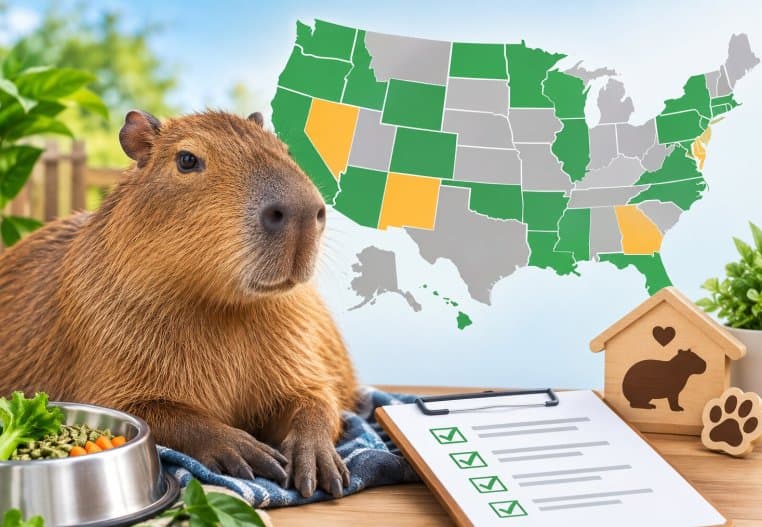
| State | Capybara status | What the rule says | Source |
|---|---|---|---|
| California | Restricted | A state permit is required to possess restricted rodents, and the exempt list does not include capybaras | California Code of Regulations, Title 14, Section 671 |
| Florida | Permit required | A Class III wildlife permit from the Florida Fish and Wildlife Conservation Commission | UF/IFAS Extension, 2017; Florida Administrative Code 68A-6.0022 |
| Georgia | License required | Rodents outside a short exempt list need a wild animal license | Georgia DNR Rule 391-4-8-.05, 2022 update |
| Texas | No state permit found | Capybaras are not on the dangerous wild animal list | Texas Health and Safety Code, Chapter 822, Subchapter E |
| Ohio | No state ban found | Capybaras are not a listed dangerous wild animal, but some cities ban them | Ohio Revised Code, Chapter 935 |
| Pennsylvania | Unclear | Exotic wildlife permit law, where coverage of capybaras depends on the definition | 34 Pa.C.S. Sections 2961 through 2965 |
| New York | Unclear | The pet ban covers wild animals as the statute defines them | Environmental Conservation Law Section 11-0512 |
| Hawaii | Import permit system | Prohibited, restricted, and unlisted animals each face limits | Hawaii Administrative Rules, Chapter 4-71 |
This guide checked the states above against statute or rule text. It does not give a verdict for the other states. The step by step section near the end shows how to check any state.
See This: Why is it Illegal to Bury a Horse?
Why California Restricts Capybaras as Rodents
California requires a state permit to possess a capybara. Title 14, Section 671 of the California Code of Regulations makes it unlawful to possess a restricted animal without a permit from the California Department of Fish and Wildlife. Capybaras are rodents, and the regulation restricts every rodent species except a short exempt list.
The exempt list names domesticated hamsters, rats, mice, guinea pigs, and chinchillas, plus muskrats under set conditions. Capybaras are not on it.
Section 671 sorts restricted animals into welfare animals and detrimental animals. Detrimental animals are species that threaten native wildlife, agriculture, or public health or safety. Rodents fall in the detrimental group.
Permits are issued only for purposes set out in Section 671.1. Treat a pet capybara as unavailable in California unless CDFW confirms otherwise in writing. Cities and counties may also prohibit restricted species or require their own permits.
How Florida and Georgia License Pet Capybaras
Florida and Georgia both require state authorization to keep a capybara. Florida requires a Class III wildlife permit from the Florida Fish and Wildlife Conservation Commission (FWC).
Georgia requires a wild animal license from its Department of Natural Resources (DNR). The two agencies use different names for the same idea: state approval to hold the animal.
Florida: Class III Wildlife Permit
Florida classifies capybaras as Class III wildlife, the lowest tier the FWC uses for captive animals. Other Class III species include rats, parrots, guinea pigs, and foxes.
A personal use application for a Class III permit includes a questionnaire on husbandry, nutrition, and behavior.
Florida has a history with escaped capybaras. In 1994, eight capybaras escaped from the Lubee Foundation in Alachua County after storm damage to a fence. All eight were recovered by 1995, but they had already started breeding.
At least 35 sightings across 13 counties had been reported by 2017, and the FWC lists the species as observed, not established.
Georgia: Wild Animal License
Georgia requires a wild animal license for rodents outside a short exempt list. The list covers Order Rodentia, the scientific group that includes capybaras, and excepts guinea pigs, chinchillas, some gerbils, golden hamsters, house mice, and two rat species.
Capybaras are not named on Georgia’s prohibited list or its inherently dangerous list, which also requires insurance.
Georgia updated its wild animal list in 2022. The previous update was in 1994. Ask DNR whether it issues a license to a private person for a pet capybara.
Where Texas and Ohio Leave Capybara Rules to Cities and Counties
Texas and Ohio do not require a state permit aimed at capybaras, but local rules can still bar one.
Texas regulates dangerous wild animals under Chapter 822 of its Health and Safety Code.
Ohio does the same under Chapter 935 of its Revised Code. Capybaras are not named in either list.
Texas: No Capybara Listing Under Chapter 822
The Texas list names animals such as lions, tigers, bears, coyotes, and chimpanzees. Owners of listed animals need a certificate of registration from the local animal registration agency.
Capybaras are rodents and fall outside that scheme. Cities and counties still set their own animal rules, so call local animal control before buying.
Ohio: A State Act That Skips Capybaras and a City Code That Names Them
Ohio bars possession of listed dangerous wild animals without a permit. The list covers animals such as lions, tigers, bears, and hyenas.
Mansfield, Ohio, lists capybaras by name among the rodents banned inside city limits. A state that allows a capybara on paper can still have towns that do not.
Why Pennsylvania, New York, and Hawaii Need a Direct Answer From the State
Pennsylvania, New York, and Hawaii each run an exotic animal system, but the published text does not settle the capybara’s status.
A buyer in these states should get a written answer from the state agency before purchase. Each state’s rule is described below.
Pennsylvania: Exotic Wildlife Possession Permit
Pennsylvania requires an exotic wildlife possession permit from the Game Commission. It is unlawful to possess, purchase, or receive exotic wildlife without one first.
The statute defines exotic wildlife with a list that “includes, but is not limited to” named groups. The commission’s reading therefore decides whether a capybara is covered.
New applicants must document two years of hands on work with the species, and each animal needs its own permit. House Bill 692, introduced in February 2025, would extend the definition to all nonindigenous animals.
New York: Wild Animal Pet Ban
New York bans keeping wild animals as pets, with exceptions for licensed and institutional holders. The ban reaches only animals inside the definition of a wild animal in Section 11-0103.
Senate Bill S252, prefiled in January 2025, would redefine the terms to cover exotic animals from other continents. New York City applies its own health code rules to wild animals.
Hawaii: Prohibited, Restricted, and Unlisted Animals
Hawaii bars any animal on its prohibited list. It requires a permit for both import and possession of restricted animals and unlisted animals.
Animals on the conditionally approved list may be imported for individual possession with an import permit. Confirm with the Department of Agriculture’s Plant Quarantine Branch where a capybara sits.
Explore Also: Where is it Legal to Own a Monkey?
Why Online Lists of Capybara Laws Disagree
Online capybara lists contradict each other, so a single list is a weak basis for a purchase. One 2026 list marks Hawaii as legal. A 2024 guide places Hawaii among the states where capybaras are banned.
Texas shows the same split. Some sites say no state permit is needed, and others say a permit is required.
Counts differ too: nine states with no permit requirement against about 30 states that allow ownership in some form.
Three causes explain most of the gaps:
- Many state laws regulate by group, not by animal name. California restricts all rodents, so capybaras are covered without being named.
- Lists mix state permits with city and county bans, and the two are different legal questions.
- Laws change. Georgia’s wild animal list went from 1994 to 2022 without an update, and Pennsylvania and New York have bills pending.
Federal Law and Capybaras: What the Animal Welfare Act Covers
No federal law bans private capybara ownership. The Animal Welfare Act (AWA), 7 U.S.C. Section 2131 and following, sets care standards for commercial dealers, exhibitors, and research facilities. It does not regulate a private pet owner.
Showing a capybara to the public can bring an exhibitor license from the United States Department of Agriculture (USDA). State and local rules still apply on top of the federal law.
How to Check Capybara Rules for Your State
Checking a state takes five steps and one email. The goal is a written answer from the agency that enforces the rule. The steps below run in order.
Step 1: Find the Agency That Regulates Exotic Animals
Most states use the wildlife agency. Florida uses the FWC, California uses CDFW, and Georgia uses DNR. Hawaii and Ohio use their Departments of Agriculture.
Step 2: Search the Species List by Group
Search for “capybara,” its scientific name Hydrochoerus hydrochaeris, and the order Rodentia. Many laws list whole groups, not single animals.
This works like a school dress code that bans all hats. It never names a baseball cap, yet the cap is covered.
Step 3: Ask the Agency in Writing
Send a short email: “Can a private person keep one capybara as a pet in this state, and which permit applies?” Keep the reply.
A written answer protects the buyer if staff change or the rule is read differently later.
Step 4: Check City and County Code
Search the municipal code for “capybara,” “rodent,” and “exotic animal.” Mansfield, Ohio, shows why this step matters. Also read the lease or homeowners association rules.
Step 5: Get Permits Before the Animal Arrives
Hold every required permit before purchase or delivery. Pennsylvania law, for example, bars buying exotic wildlife before the permit is issued.
Buying from another state does not change the rules where the animal will live.
Conclusion
A capybara is legal to own in some states, restricted in others, and unclear in a few.
California, Florida, and Georgia regulate the animal through state rules, while Texas and Ohio leave much of the decision to local law. Pennsylvania, New York, and Hawaii need a direct answer from the state.
The sequence that works is to read the state species list, email the agency, check city and county code, and hold every permit before the animal arrives.
This guide is general information, not legal advice. Rules vary by state and change over time, so consult a licensed attorney or the state wildlife agency before buying a capybara.