
Facing court for a speeding ticket can feel stressful, but knowing what to say can help you present your case with confidence.
Decide your plea beforehand, address the judge respectfully, and focus on relevant facts rather than weak excuses. If you plan to contest the ticket, bring supporting evidence such as dashcam footage, your driving record, or details about road conditions and speed-measuring equipment.
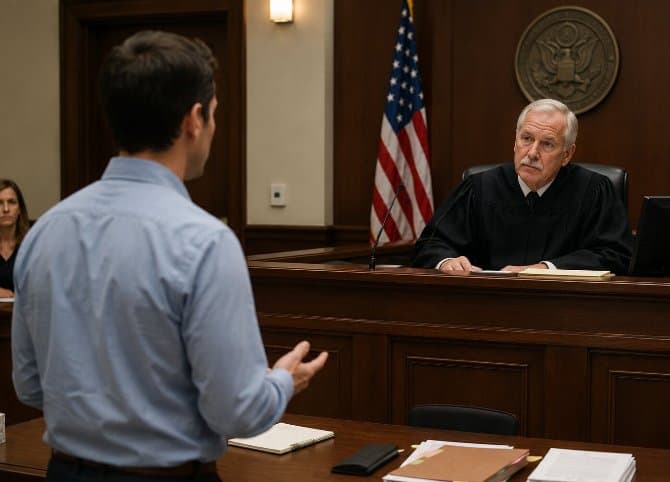
Should You Plead Guilty or Not Guilty
Your plea decision comes before anything you say to the judge, and it shapes the rest of the hearing.
A guilty plea works best when the ticket is accurate and your goal is a lighter penalty.
A not guilty plea works best when you have a real dispute about the facts, such as the speed reading, the posted limit, or whether the officer had a clear line of sight.
See This: What is the Most Common Punishment for Reckless Driving?
What to Say if You Plead Guilty
If you plead guilty, the goal is a shorter sentence, not a debate. Judges respond well to drivers who take responsibility quickly and then make a specific, reasonable request. Rambling explanations or excuses tend to backfire.
A short, effective statement sounds like this: “Your Honor, I plead guilty. I understand I was driving faster than the posted limit, and I take responsibility for that. I have a clean record over the last five years, and I would respectfully request traffic school so I can avoid points on my license.”
Keep it under thirty seconds. Do not add a story about why you were speeding unless the judge asks.
Useful details to mention, if true, include a clean driving record, enrollment in a defensive driving course, or a commercial license that depends on a clean record.
Each of these gives the judge a concrete reason to grant leniency instead of a vague appeal to sympathy.
What to Say if You Plead Not Guilty
A not guilty plea shifts the burden to the officer and the prosecution to prove the citation is accurate.
Your statement should stick to facts that raise real doubt, not general complaints about being treated unfairly.
Effective lines of questioning include asking whether the radar or laser device was calibrated and tested on the day of the stop, asking what training the officer has on that device, and asking where the officer was positioned relative to your vehicle when the reading was taken.
If your defense depends on road conditions, describe the specific conditions, such as clear visibility, dry pavement, and light traffic, rather than saying the speed “felt safe.”
You are also entitled in most jurisdictions to request the officer’s calibration and maintenance records for the device used to measure your speed. If the officer cannot produce them, that gap can support your case.
What Not to Say in Traffic Court
Certain statements almost never help you and can hurt your credibility with the judge. Avoid claiming you did not know the speed limit, since drivers are expected to know posted limits on roads they use.
Avoid inventing a personal emergency unless you can back it up with real evidence, because unsupported emergency claims are one of the least successful defenses drivers attempt.
Do not argue with the officer while they are testifying, and do not interrupt the judge. Save your response for when you are asked to speak.
Do not point out a minor clerical error, like a misspelled name, and expect the ticket to be dismissed on that basis alone, since small errors rarely invalidate a citation.
How to Prepare Your Statement Before Your Court Date
A written outline keeps you from freezing up or wandering off topic once you are standing in front of the judge.
Practicing out loud, even just a few times at home, makes a noticeable difference in how confident and clear you sound.
Before your hearing, review your citation for the exact code section, speed, and location listed. Gather any evidence that supports your version of events, including dashcam footage, photos of the road or signage, or witness statements.
Write a two or three sentence opening statement and a short list of any questions you plan to ask the officer if you are contesting the ticket.
How to Behave and Dress in Court
How you present yourself affects how the judge and court staff treat you, even before you say a word. Dress the way you would for a job interview, in business casual clothing with no logos, ripped clothing, or overly casual items.
Arrive early, turn off your phone, and stand when the judge enters or addresses you directly. Address the judge as “Your Honor” every time you speak to them, and refer to the officer as “Officer” followed by their last name if you know it.
Speak clearly, keep your hands still, and avoid crossing your arms, since small habits like these can make you seem defensive even when you do not mean to be.
Conclusion
What you say in traffic court matters less than how well you prepare it. Decide your plea ahead of time, write out a short statement, gather any real evidence you have, and dress and behave the way you would for a formal interview.
A guilty plea paired with a specific, reasonable request for leniency often works better than a long explanation, and a not guilty plea works best when it focuses on facts the officer cannot verify rather than general complaints.
Confirm the specific rules for your state and court before your hearing, since procedures for pleas, evidence, and alternatives like traffic school vary widely.