
Petty Theft and Grand Theft describe the same basic act, taking someone else’s property without permission, but the law splits them apart based mostly on dollar value.
Cross a state’s threshold and a misdemeanor becomes a felony. This guide breaks down how that threshold works, how it differs across the country, and what else can push a charge from petty to grand even when the price tag looks small.
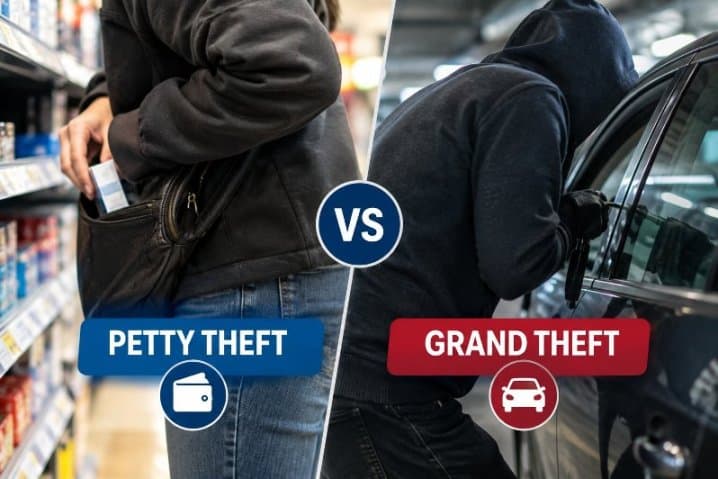
What is Petty Theft?
Petty Theft is the unlawful taking of property valued at or below a state’s set dollar threshold, and it is almost always charged as a misdemeanor.
It covers everyday acts like shoplifting a shirt, walking off with a package left on a porch, or failing to scan an item at self checkout.
Because it is a misdemeanor, petty theft typically carries lighter consequences: fines, probation, restitution, or up to a year in county jail depending on the state.
A first time petty theft charge with no prior record often resolves without jail time, though it still creates a criminal record that can affect background checks and job applications.
What is Grand Theft?
Grand Theft is the unlawful taking of property that exceeds a state’s dollar threshold, or that falls into a special category the law treats as serious regardless of price.
It is usually chargeable as a felony, which brings a far heavier range of penalties than petty theft.
In many states, including California, grand theft is a “wobbler,” meaning the prosecutor decides whether to file it as a misdemeanor or a felony based on the value involved, the defendant’s criminal history, and the circumstances of the theft.
A felony grand theft conviction can carry years in state prison, while a misdemeanor version might result in county jail time closer to petty theft penalties.
The Dollar Threshold: How States Draw the Line
There is no single national number that separates petty theft from grand theft. Each state legislature sets its own dollar figure, and that figure decides which category a theft falls into.
The lowest threshold in the country sits at $200, while the highest reaches roughly $2,500. Most states fall somewhere in between, with several clustering between $500 and $750 and another cluster landing around $1,000.
Some states do not use the terms “petty theft” and “grand theft” at all. Instead, they classify the offense by degree, such as first degree theft or second degree theft, or they simply label it misdemeanor theft versus felony theft.
The label differs, but the underlying mechanic stays the same: the dollar value of the property drives how serious the charge becomes.
Why the Threshold Number Isn’t the Whole Story
A low dollar value does not automatically mean a misdemeanor, and a high one does not automatically mean prison. Several factors beyond price can move a case from petty to grand.
Property type. Many states carve out categories that count as grand theft no matter what the item is worth. Vehicles and firearms are the most common examples, and some states add livestock to that list.
Aggregation of multiple thefts. Prosecutors do not have to look at each theft in isolation. If someone takes smaller amounts on separate occasions within a defined window, often 90 days, and the state can show the thefts were part of one general scheme, it can add the values together and charge the total as a single grand theft. California’s Assembly Bill 2943, fully active in 2026, gives prosecutors this exact tool for repeat retail thef.
Criminal history. A prior theft conviction can change how a new, otherwise minor theft gets charged. In California, for example, a person with two or more prior theft or drug convictions can have a new petty theft charged as a felony under current sentencing rules.
Victim type. Theft from a government agency, an employer, or a vulnerable victim can trigger different statutes or sentencing enhancements that do not apply to an ordinary retail theft.
How Prosecutors Determine Property Value
Value disputes are one of the most common battlegrounds in theft cases, because the dollar figure alone often decides the charge.
Prosecutors typically rely on market value at the time of the theft, meaning what the item would have sold for, not necessarily its original retail price or replacement cost.
Retailers sometimes report inflated numbers based on full retail price or replacement cost rather than the item’s actual resale value.
A defense attorney can challenge this by bringing in receipts, markdown records, or an independent appraisal to show the true market value. If that pushes the total below the felony threshold, a grand theft charge can be reduced to petty theft.
For intangible property, such as data, proprietary research, or confidential information, valuation gets harder.
Prosecutors may calculate development costs or potential resale value, and defense teams often bring in competing experts to challenge those figures.
Federal Theft: A Separate System
State thresholds do not apply to federal crimes. When the property belongs to the United States government, the case falls under 18 U.S.C. Section 641, which sets its own line at $1,000.
Property worth $1,000 or less is a misdemeanor under this statute, carrying up to one year in federal prison. Property worth more than $1,000 is a felony, carrying up to ten years.
The statute covers a wide range of conduct beyond simple theft, including embezzlement by government employees, unauthorized use of federal property, and knowingly receiving stolen government property.
As with state cases, courts can combine the value of property stolen across multiple incidents in a single prosecution.
Conclusion
Petty theft and grand theft come down to a dollar line that each state sets on its own, running from about $200 to $2,500 depending on where the case is filed. That number is the starting point, not the whole answer.
Property type, prior convictions, and aggregation of multiple incidents can all move a case across that line in either direction.
Anyone facing a theft charge should confirm the exact threshold and rules in their state rather than assuming a number from a different jurisdiction applies.