
South Carolina is the only U.S. state with a clear statewide ban on magnet fishing. There is no federal law that bans the hobby nationwide. Everywhere else, legality depends on who owns the land or water, what you pull out, and whether a local rule applies.
That means a bridge over a public river can be fine in one county and off limits in the next. The sections below cover each layer of rules, starting with the one state that has banned it.
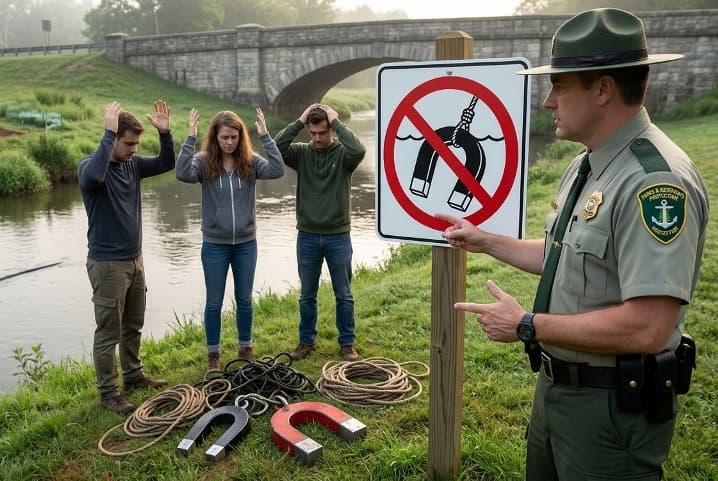
Why South Carolina Bans Magnet Fishing
South Carolina prohibits magnet fishing in its waterways under the Underwater Antiquities Act of 1991. The state’s Institute of Archaeology and Anthropology (SCIAA) runs a Hobby License for small, noncommercial recovery of submerged items, but it does not issue that license for magnet fishing.
SCIAA gives a plain reason. A person on the surface cannot see what the magnet has snagged, so they cannot tell if it is partly buried or attached to metal hardware on a shipwreck or other historic structure.
The Hobby License application also states that a Hobby License does not permit bottom disturbance in any South Carolina waterway. Holding the license does not give you a loophole.
Oklahoma State Parks Ban Magnet Fishing
Oklahoma prohibits magnet fishing at every state park. The state parks FAQ answers the question directly: magnet fishing and metal detecting are prohibited at all state parks.
This is a property rule, not a statewide ban. Oklahoma waters outside state parks follow other rules, such as trespass law and any local ordinance.
Other states and cities set similar limits through park rules and local ordinances. Check the managing agency for the exact spot before you go.
What Federal Law Says About Magnet Fishing on Public Land
Federal law makes it a crime to remove an archaeological resource from federal or tribal land without a permit.
The Archaeological Resources Protection Act (ARPA) of 1979 defines an archaeological resource as material remains of past human life that are of archaeological interest and at least 100 years old.
Magnet fishing is not named in the law. The risk is what ends up on the magnet. A rusted tool, a coin, or a piece of an old structure pulled from a federal waterway can fall under ARPA.
Federal land managers issue permits for excavation or removal, and the Bureau of Indian Affairs describes criminal penalties that range from fines and up to a year in prison to larger fines and up to five years for serious violations. If you find something old on federal land, leave it in place and report it to the land manager.
Where is Magnet Fishing Illegal Outside the United States?
Magnet fishing is restricted in several countries, usually through canal rules or heritage law rather than a law that names the hobby. The clearest examples are the canals of England and Wales and the historic canals of Canada.
England and Wales
The Canal & River Trust manages more than 2,000 miles of waterways in England and Wales and states that it does not permit magnet fishing on them.
The Trust cites the General Canal Bylaws 1965, which bar removing material from a canal without authorization and carry a £25 fine (The Sunday Telegraph, 2018).
In 2018 the Trust said its approach was to avoid legal action against first time offenders. The practice is still prohibited on its waterways.
Canada
Parks Canada forbids magnet fishing in its historic canals. It says the activity breaks section 11.2 of the Historic Canals Regulations, and failing to comply is an offence that may result in fines.
Parks Canada gives three reasons. Stirring up the bottom can disturb habitat and release contaminated sediment, canal structures can be damaged, and archaeological remains may be destroyed.
Germany, France, and the Netherlands
Magnet fishing without a permit is punishable by fine in Hamburg, Germany. A magnet fishing retailer’s guide reports that France requires prior state authorization and that the Netherlands heritage inspectorate prohibits it in most cases.
These are secondary sources. Confirm with the local authority before you fish in any of these countries.
Why Authorities Ban Magnet Fishing?
Authorities give three main reasons: protecting historic sites, protecting people, and protecting infrastructure.
Each reason shows up in the official statements above, which is why bans appear in places with canals, shipwrecks, and heritage waters.
Historic sites come first. A magnet can drag an object out of the sediment or off a wreck, and the object loses its link to the place it came from.
Personal danger is the second reason. Magnet fishers have pulled up weapons and explosives.
In Leicester in 2020, the Chief Constable said police wanted a solution that avoided calling out bomb disposal teams and shutting off parts of the city center. In June 2018, a father and son drowned while magnet fishing in a canal in Huddersfield.
Infrastructure is the third. Canals include bridges, weirs, and conduits that dragging and disturbing the bottom can damage.
How to Check Whether Magnet Fishing is Allowed at Your Spot
Before you drop a magnet, confirm three things: who owns or manages the water, whether the site has heritage protection, and what the rules say about items you find. If you cannot answer all three, do not fish there yet.
A short routine works well:
- Look up the manager of the waterway, such as a state park, a city, a federal agency, or a canal authority, and read its rules on magnet fishing and metal detecting.
- Ask the landowner for permission if the bank or bridge is private, because fishing from private property without permission is trespassing.
- Contact the state historic preservation office or archaeology agency if the water has known shipwrecks, battlefields, or old structures nearby.
What to Do If You Pull Up a Weapon, Explosive, or Old Artifact
Stop fishing, move people away, and call the police if the find looks like a weapon, ammunition, or an explosive.
Do not carry it, clean it, or take it home. In Leicester, the Canal and River Trust appealed to people to stop retrieving objects from the water after a marked rise in dangerous finds, including unexploded munitions.
For an item that looks old, photograph it where it lies and report it to the land manager or the state archaeology office. On federal land, removal without a permit can break ARPA if the item is at least 100 years old.
Conclusion
Magnet fishing is legal in many places, but the list of exceptions is long and set by the landowner or manager of each waterway.
South Carolina is the clearest statewide ban in the United States, and canal authorities in the U.K. and Canada prohibit it on their waters.
Before you drop a magnet, find the agency or owner in charge of the water, read its rules, and ask when the answer is unclear. A short email costs less than a fine, and it protects both you and the history under the water.
This article is general information, not legal advice. Laws vary by state, country, and local jurisdiction, and they change. Consult a licensed attorney or the managing agency for your exact situation.