A secured bail bond requires cash, property, or a bail company’s guarantee before the defendant leaves jail. An unsecured bail bond requires only a signed promise to pay the full bail amount if the defendant misses court.
Unsecured bonds get more people home: a Colorado study of 1,919 cases found that 94% of defendants with unsecured bonds left jail, compared with 61% of those with secured bonds.
The downside is the debt. One missed court date on an unsecured bond can leave the defendant owing every dollar of the bail.
What is a Secured Bail Bond?
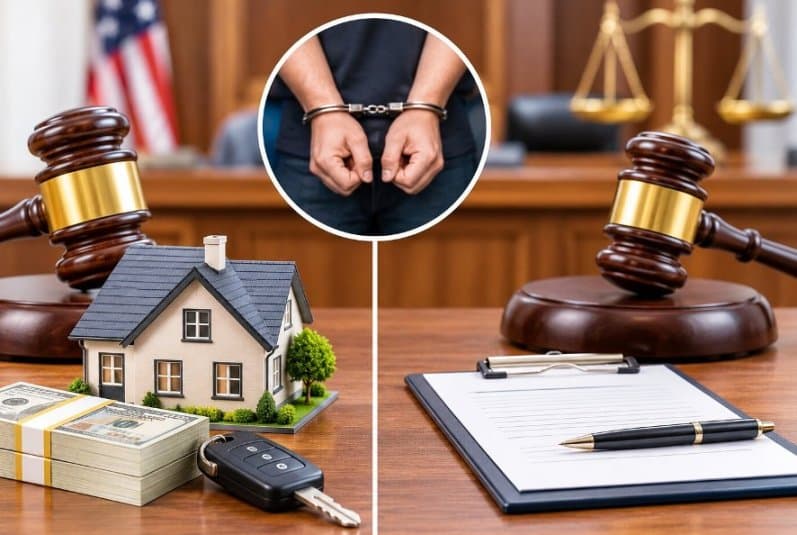
A secured bail bond is a bond backed by money or property that the court can collect if the defendant misses court.
A licensed bail company’s guarantee also counts as that backing. “Secured” means the court already holds the money, or has a firm claim on it, before the defendant walks out.
Secured bonds come in four common forms:
- Full cash bond: The defendant or family pays the entire bail amount to the court. The court returns it after the case ends, though some courts first take out fees or unpaid fines.
- Deposit bond: The court accepts a percentage, often 10%, and the defendant is liable for the rest after a missed court date. This is a partly secured bond.
- Property bond: Real estate is pledged to the court. Most courts require equity at least equal to the bail amount, which means appraisals and title paperwork.
- Surety bond: A bail bond company guarantees the full amount to the court in exchange for a fee, called a premium, and sometimes collateral.
Surety bonds are the most common route. Among felony defendants in large urban counties, surety bonds passed release on recognizance in 1998 as the most used type of pretrial release.
What is an Unsecured Bail Bond?
An unsecured bail bond is a release where the defendant signs a written promise to pay a set dollar amount only if they miss court or break release conditions.
No money changes hands at the jail. People also call it a signature bond or a personal bond.
Pennsylvania’s court rules give a clear definition. The defendant agrees in writing to be liable for a fixed sum if they fail to appear or fail to follow the bail conditions.
The state’s rule commentary adds that an unsecured bond is a monetary condition, yet no money or security is deposited.
An unsecured bond is close to release on recognizance (ROR), with one difference. ROR has no dollar figure attached. An unsecured bond names a figure, such as $5,000, that turns into a debt the moment the defendant skips court.
In federal court, an unsecured appearance bond is the default. Judges must order release on personal recognizance or an unsecured appearance bond unless that release would fail to assure appearance or would endanger another person or the community.
The Two Meanings of “Unsecured” You Will Hear
Courts and bail agencies use these words differently. To a judge, “unsecured” means a signature bond with nothing paid. To a bail bondsman, “unsecured” usually means a surety bond written without collateral, where you still pay the premium.
Here is how bail agencies tend to split their own bonds. A secured surety bond means you pay the premium and pledge collateral, such as a car title or a house deed. The agency holds the collateral until the case ends.
An unsecured surety bond means you pay the premium, but the agency accepts a cosigner’s signature and credit history in place of collateral.
From the court’s point of view, both agency versions are secured bonds, because a surety company has guaranteed the full amount. This mix of meanings explains why one website calls an unsecured bond free while another says it costs 10%.
Before you call a bondsman, ask the jail clerk or the defense attorney exactly what the judge ordered. If the judge set an unsecured court bond, you do not need a bondsman at all, and paying one is wasted money.
Where the Money Goes: One $10,000 Bail Set Four Ways
The same $10,000 bail can cost a family nothing or cost them $10,000, depending on the bond type. The table follows one defendant through two outcomes: attending every court date, and missing one.
| Bond Type | Paid Before Release | Recovered If Every Court Date Is Kept | Owed If a Court Date Is Missed |
|---|---|---|---|
| Full cash bond | $10,000 | Most or all of the $10,000 | The $10,000 is forfeited |
| Surety bond with collateral | About $1,000 premium, plus collateral pledged | Collateral returned; premium kept by the agency | Collateral can be taken, plus any balance up to $10,000 |
| Surety bond without collateral | About $1,000 premium | Nothing; the premium is the agency’s fee | Defendant and cosigner owe the agency up to $10,000 |
| Unsecured court bond | $0 | Nothing to recover, nothing lost | Defendant owes the court $10,000 |
The premium figures use the 10% rate common in California. Other states set different caps or leave rates unregulated, so ask for the rate in writing.
For a family confident the defendant will show up, the unsecured bond is the cheapest path. Full cash comes next if the family can afford it, because most of that money comes back.
The bondsman’s premium is the one cost that never returns, even if the charges are dropped the next morning. If you are deciding between a bondsman and paying the court yourself, our guide to surety bail bonds versus cash bail bonds compares the costs and refund rules side by side.
Collateral is different from the premium. California regulations require a bail licensee to return collateral immediately once a court order ends liability on the bond. Other states have their own return rules, so keep every receipt the agency gives you.
How Judges Choose Between a Secured and Unsecured Bond
Judges pick the bond type based on how likely the defendant is to return to court and whether release puts anyone at risk.
Lower risk defendants tend to get an unsecured bond or ROR. Higher risk defendants get a secured bond or, in some cases, no bail at all.
The charge level matters too, since lower level misdemeanor charges are more likely to qualify for an unsecured bond or ROR. Our breakdown of felony bonds vs misdemeanor bonds explains how the charge changes both the bail amount and the bond type.
Judges commonly weigh:
- The charge and the possible sentence
- Prior record, especially past failures to appear
- Ties to the area, such as steady work and family nearby
- Any history of breaking probation or earlier release conditions
- The defendant’s ability to pay
Federal law tells judges to use the least restrictive condition, or combination of conditions, that will reasonably assure appearance and safety.
Pennsylvania’s rules say any monetary condition must be no greater than necessary to ensure appearance and compliance. Many states use similar wording, but how closely judges follow it varies by county and by courtroom.
The research gives defense attorneys a strong argument for unsecured bonds. In the Colorado study, higher secured bond amounts were not linked to better court appearance rates, but they were linked to more jail bed use.
What Happens If the Defendant Misses Court
A missed court date leads to forfeiture under either bond type, plus a bench warrant for the defendant’s arrest. What changes is who loses money and how fast.
With a cash or property bond, the court keeps the cash or moves against the pledged property. With a surety bond, the court demands the full amount from the bail company.
The company then turns to the defendant, the cosigner, and any collateral to recover its loss. Where state law allows, the company can also hire a recovery agent to return the defendant to custody.
With an unsecured bond, nobody posted money, so the court enters a debt against the defendant for the full amount. That debt can be collected like a civil judgment.
Many courts will set aside a forfeiture if the defendant returns quickly with a valid reason, such as a hospital stay or a car accident on the way to court.
Calling the defense attorney or the court clerk the same day gives the defendant the best chance to undo the damage.
How to Ask for an Unsecured Bond or a Lower Bail
A defendant can ask the judge to change a secured bond to an unsecured one, or to lower the amount, at the first bail hearing or through a later motion. These four steps give the request its best chance.
Step 1: Ask at the First Appearance
Raise the request at the first appearance or arraignment, when bail is first set. Judges decide quickly at this stage, so the defense attorney or public defender should be ready to say why an unsecured bond is enough.
Asking later is possible, but changing an order already in place is harder.
Step 2: Bring Proof of Ties to the Community
Family members can gather pay stubs, a lease or mortgage statement, a letter from an employer, and school or caregiving records.
These papers show the judge that the defendant has reasons to stay and return to court. Hand them to the attorney before the hearing so they can be shown to the judge.
Step 3: Offer Nonmonetary Conditions
Propose conditions that address the judge’s concern without money, such as pretrial check ins, a curfew, electronic monitoring, or surrendering a passport.
Pennsylvania lists release on nonmonetary conditions as its own type of bail. Offering conditions up front often makes an unsecured bond easier for a judge to approve.
Step 4: File a Motion to Modify Bail
If the judge sets a secured bond anyway, the attorney can file a motion to reduce or modify bail.
Pennsylvania allows modification before verdict under Pa.R.Crim.P. 529, and federal defendants can seek review of a release order under 18 U.S.C. § 3145. New facts, such as a new job offer or a medical need, make the motion stronger.
State Rules That Change the Answer
Bail is mostly governed by state law, so the choice between secured and unsecured bonds depends on where the arrest happened. A few states have rules that change the picture completely.
Illinois abolished commercial bail bondsmen in 1963 and became the first state to end cash bail on September 18, 2023. Under the Pretrial Fairness Act, part of the SAFE-T Act, judges can hold someone only if they meet criteria showing a flight risk or a danger to the community.
Kentucky, Oregon, and Wisconsin also prohibit commercial bail bonding. Wisconsin banned it in 1979.
In these states, families pay deposits or cash bail directly to the court, and there is no bondsman premium.
Pennsylvania lists the unsecured bail bond as one of five types of release, alongside ROR, nonmonetary conditions, nominal bail, and monetary bail.
California has regulated the bail bond business through its Department of Insurance since the Bail Bond Regulatory Act of 1937. Families there can check an agent’s license with the department before signing anything.
Frequently Asked Questions
Is an unsecured bail bond free?
Yes, as long as the defendant attends every court date and follows all release conditions. No money is paid at the jail. If the defendant misses court, the full bail amount becomes a debt owed to the court.
Do I need a bail bondsman for an unsecured bond?
No. An unsecured court bond only requires the defendant’s signature, so there is nothing for a bondsman to post. If someone offers to sell you a bond after the judge set an unsecured bond, confirm the bond type with the court clerk first.
Do I get my money back on a secured bail bond?
It depends on who you paid. Cash paid directly to the court comes back after the case ends, though some courts take out fees or fines first. A premium paid to a bail bondsman does not come back, but pledged collateral is returned once the bond is cleared.
What is the difference between an unsecured bond and release on recognizance?
Both release the defendant without upfront payment. ROR is a promise to return to court with no dollar amount attached. An unsecured bond sets a dollar amount that the defendant owes if they fail to appear.
Can a secured bond be changed to an unsecured bond later?
Yes. The defense can file a motion to modify bail, and the judge can change the bond type or amount. Motions work best when they bring new information, such as proof of a job or housing that the judge did not have at the first hearing.
Conclusion
The difference between secured and unsecured bail bonds comes down to when the money is at risk. A secured bond asks the family to pay or pledge before release. An unsecured bond asks for nothing until a court date is missed, then asks for everything.
For most families, the smartest move is to ask for an unsecured bond at the first hearing, bring proof of community ties, and confirm the bond type with the court before calling a bondsman.
If a secured bond is set, compare the cost of cash bail against a nonrefundable premium, and get every collateral agreement in writing.
Legal disclaimer: This article is general information, not legal advice. Bail rules and bail bond fees vary by state and by county. For advice about a specific case, contact a licensed criminal defense attorney in the state where the charges were filed.